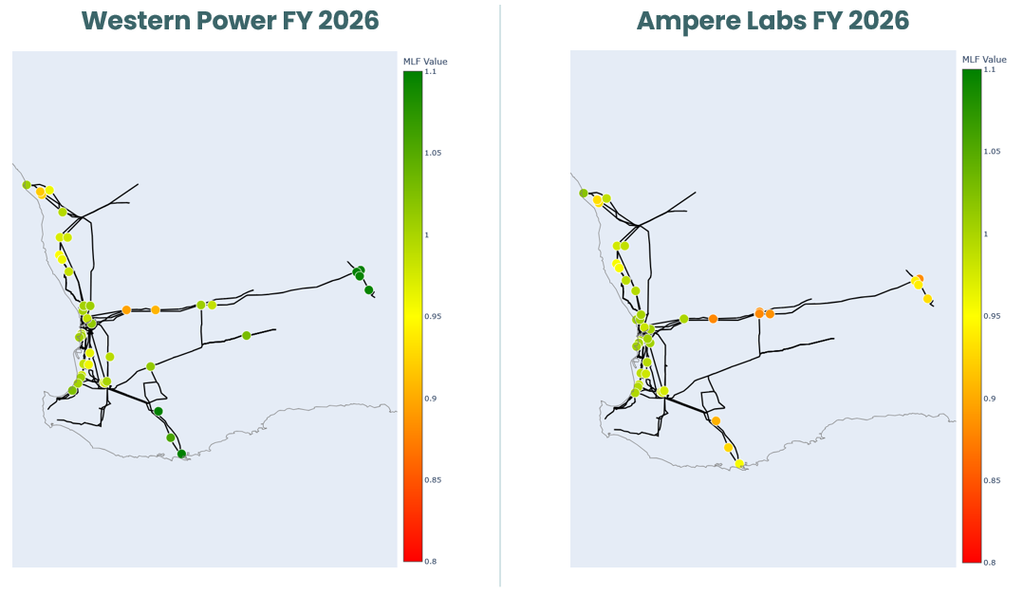
We use a detailed power flow model of the SWIS transmission network to calculate Transmission Loss Factors (TLF), based on an approach that is very similar to Western Power’s TLF methodology.
Our high-level approach for calculating forward looking TLFs is as follows:
1. Network model configuration
- Apply any relevant network changes.
- Apply the inputs from the market model to the network model, e.g., dispatch outcomes.
2. Run an AC power flow
- The AC power flow hierarchy generally attempts to solve with as few degrees of freedom as possible.
- A converged power flow solved with control and reactive limits best represents reality.
- We attempt to tune the models as best as possible to achieve low divergence rates.
3. Apply AEMO’s balancing process and rerun the AC power flow
- We use the supply-demand balancing approach detailed in section 5.5 of AEMO’s Forward Look Loss Factor Methodology v9.
- Note that this approach is not necessarily used by Western Power in the calculation of TLFs (and is not considerable in the short to medium term), but becomes necessary for longer term projections.
4. Extract the interval-level MLF
- We use the solved power flow Jacobian matrix to obtain sensitivities (which are effectively the interval-level marginal loss factors).
5. Post process TLFs for each financial year.
- The interval-level MLFs are volume-weighted and aggregated to determine static average TLFs for a full financial year.
To validate our approach, we independently calculated the TLFs for FY 2025-26 using the actual historical dispatch for FY 2025-26. A comparison of the calculated results vs Western Power’s official results is shown in the figure below, indicating good alignment between the calculations.