

This post provides a short technical survey on where we (the electricity industry) are currently at with operating 100% inverter-based resource (IBR) power systems. Note that this survey is based on publicly available information and may not include all project experience (i.e. proprietary projects).
Small-scale Systems
There are numerous examples of small <1 MW hybrid solar, battery energy storage system (BESS) and diesel microgrids around the world that can operate at 100% IBR, most commonly deployed in off-grid rural electrification projects. These hybrid systems tend to be co-located at a single site, controlled by a centralised controller and the BESS is the only grid-forming device.
The SMA Sunny Island product line of BESS inverters pioneered the use of distributed AC-coupled solar PV using a novel over-frequency droop control scheme to manage excess solar production. The grid-forming Sunny Island BESS inverter ramps up grid frequency when there is excess generation (and batteries are fully charged), which triggers the over-frequency droop control in the solar PV inverters and reduces solar generation.
Side note: In commercial and industrial systems, double-conversion uninterruptible power supply (UPS) systems are also an example of small 100% IBR systems (on the load side) that have been around for many years and pre-date the concept of hybrid microgrids.
Larger Off-Grid Systems
As systems get larger, there is a tendency for synchronous condensers to be added to the mix, to provide a grid reference (grid-forming), inertia (with a flywheel), fault current (system strength) and dynamic voltage control. However, this is not always the case and there are a few examples of pure IBR solutions.
Gotland system
The island of Gotland in Sweden is supplied by an HVDC link from the mainland (at Västervik). The HVDC link was commissioned in 1954 and was also the first commercial subsea HVDC project. Gotland previously had no local generation, so it was also the first large-scale 100% IBR system in the world (supplying a peak load of ~160 MW).
Four synchronous condensers (with total capacity of 196 MVA) provided the grid reference, voltage support and inertia on the island. The HVDC link provided frequency regulation and contingency frequency support. See section 9.2 of IEEE Std 1204-1997 for more details.
Belleveue Gold Mine system
A 90 MW standalone mining power system in Western Australia, comprising 24 MW thermal generation (gas and diesel), 24 MW wind, 27 MW solar, 15 MW / 33 MWh BESS and a 5 MVA synchronous condenser. The system recently achieved 155 consecutive hours of “engines off” 100% IBR operation.
Dalrymple BESS microgrid
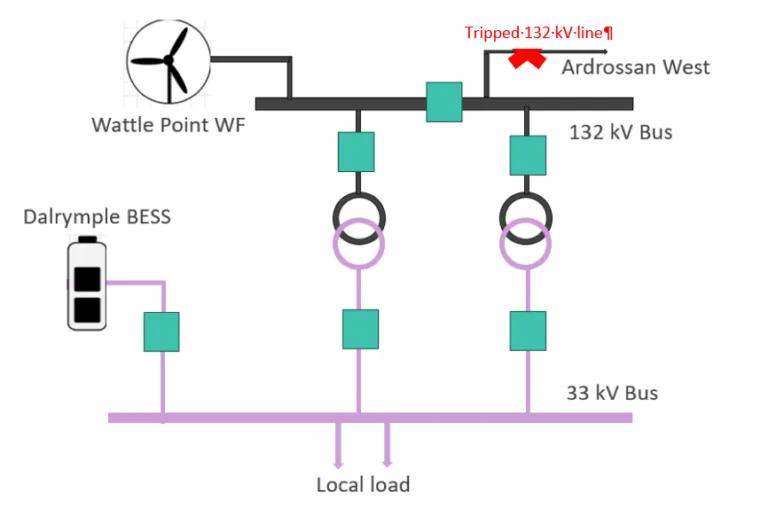
The 30 MW / 8 MWh ESCRI ElectraNet BESS located at Dalrymple in South Australia is a grid-forming BESS that can operate either in i) grid-connected mode with the rest of the NEM or ii) autonomously as an island supplying the lower Yorke Peninsula. The BESS can operate in conjunction with the 90 MW Wattle Point wind farm (via a collector tripping scheme) and ~3.4 MW of rooftop PV, demonstrating successful 100% IBR operation between distributed IBR facilities without the use of a synchronous condenser.
King Island microgrid
A 10 MW standalone power system on King Island in the Bass Strait north-west of Tasmania, comprising 6 MW diesel generation, 390 kW solar PV, 2.45 MW wind, 3 MW / 1.5 MWh BESS, diesel UPS (D-UPS) and dynamic resistor. The D-UPS effectively acts like a synchronous condenser in normal operation, providing a synchronous grid reference and supplying inertia.
Port Gregory microgrid
A fringe-of-grid system at Port Gregory in Western Australia, comprising a 2.2 MW bi-directional back-to-back converter (AC-DC-AC) with 0.5 MWh of battery storage, 2.5 MW of wind and 1 MW of solar. The back-to-back converter interfaces with a fringe, unreliable part of the grid and can operate in both i) grid-connected mode and ii) autonomous island mode with the load-side converter forming the grid. This project is another example of a 100% IBR system integrating multiple IBR facilities without the use of synchronous condensers.
Public Utility Grids
From our survey, there are currently no public utility grids that have successfully operated at 100% IBR penetration. However, there are several systems that have reached very high IBR penetrations.
Note that 100% IBR penetration is distinct from operating at 100% renewable energy or zero-emission generation, which may include nuclear, hydro and biomass generators that still employ synchronous machines.
Tasmania system
The Tasmania system is a region of the NEM that is asynchronously connected via a subsea HVDC link (Basslink). Between the HVDC link (500 MW) and wind capacity (568 MW), there is nearly enough IBR capacity to supply the average operational demand of 1,190 MW. The system also has 2,295 MW of hydro capacity, of which 13 units are able to operate in synchronous condenser mode.
With the synchronous condensers providing inertia and system strength support, the Tasmania system has operated up to 92% IBR penetration in the past.
South Australia island system
The South Australia (SA) system is a region of the mainland NEM that is normally interconnected with Victoria and New South Wales (via Project EnergyConnect). Under normal operation, the SA system has seen periods of >100% IBR penetration (relative to underlying demand), although it still operates thermal (gas-fired) generators for system security purposes, for example:
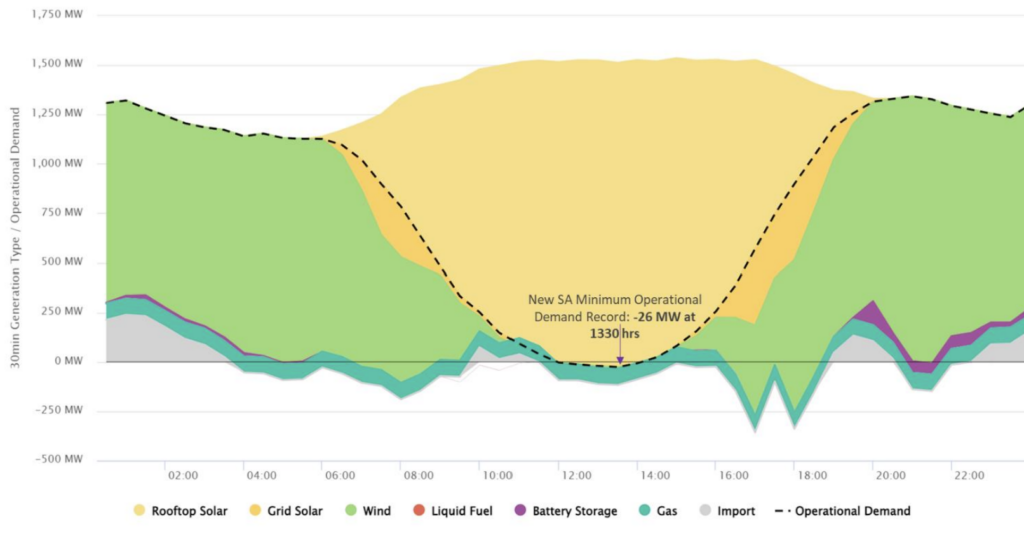
However, even when separated from the rest of the NEM and operating as an autonomous island, SA is still able to operate at very high IBR penetrations. For example, during the SA islanding event from 12 to 17 November 2022, the system recorded a peak instantaneous IBR penetration of 91.5%.
The SA system has 10,581 MW of registered capacity (as at November 2025), comprising 2,763 MW of wind, 2,661 MW of rooftop PV, 2,569 MW of gas-fired generation, 1,072 MW of BESS, 1,068 MW of solar PV and 448 MW of diesel. Four synchronous condensers (at Davenport and Robertstown) provide a baseline level of synchronous inertia and system strength.
Desktop EMT studies conducted by AEMO in 2023 indicate that the SA island system is capable of operating at 100% IBR, with the synchronous condensers providing the grid reference (grid-forming).
South West Interconnected System
The South West Interconnected System (SWIS) is the largest power system in Western Australia. It is an islanded system with no interconnectors and has a peak demand of ~4.5 GW.
The system has 9,431 MW of registered capacity (as at January 2026), comprising 3,120 MW of gas, 2,157 MW of DER (rooftop PV and residential BESS), 1,325 MW of BESS, 1,199 MW of coal, 1,197 MW of wind, 251 MW of solar PV, 122 MW of diesel and 60 MW of bioenergy and other generation technology.
On 20 December 2025, the SWIS recorded an instantaneous IBR penetration of 91.1%.
Kaua’i system
The Kaua’i island system in Hawai’i is a standalone system with peak demand of ~90 MW, operated by the Kaua’i Island Utility Cooperative (KIUC). The system comprises 110.5 MW of fossil-fuel thermal generation, 78 MW of solar PV, 47 MW / 222 MWh of BESS, 16.25 MW of hydro and 6.7 MW of biomass. The Kapaia GE LM2500 gas-turbine generator is fitted out with a clutch and can operate in synchronous condenser mode, providing inertia, voltage control and fault current support for the system.
The system has operated at 100% renewable energy penetration and has reached ~85% IBR penetration.
What else do we need to do to prove 100% IBR operation?
There is ample evidence to suggest that 100% IBR operation in large-scale grids is practically feasible (and not just a theoretical possibility). In fact, the Gotland system demonstrated that this was possible (with the help of synchronous condensers) over 70 years ago.
So what is stopping utilities and system operators? We offer a few possible reasons:
- For systems like Kaua’i, there is no real driver to test 100% IBR operation as the system can already operate at 100% renewable penetration (with biomass and hydro).
- For systems like Tasmania, it may be simply a lack of investment as the AEMO/TasNetwork 100% IBR generation study indicates that the system is just a few asset investments away from being able to operate at 100% IBR (e.g. BESS and system strength support in Southern Tasmania).
- The inherent conservativeness of utilities and system operators that serve the public is no doubt also a factor (e.g. the political and economic consequences of a botched test affecting thousands to millions of people are significant).
There are also other field tests that may be worth proving out. For example, the larger systems that have reached 100% IBR (e.g. Dalrymple, Port Gregory) tend to have a single grid-forming inverter that manages balancing and reserves. System operation with multiple grid-forming inverters and decentralised control is a scenario that could be worth testing in a more limited way (e.g. by isolating a small region of the grid).
A glimpse of multiple grid-forming inverters in action, albeit inadvertently, was in Fortescue’s Pilbara grid when a non-credible contingency tripped all thermal generation from the system. The system did not collapse and was held up by a solar farm and two grid-forming BESS hundreds of kilometres apart.